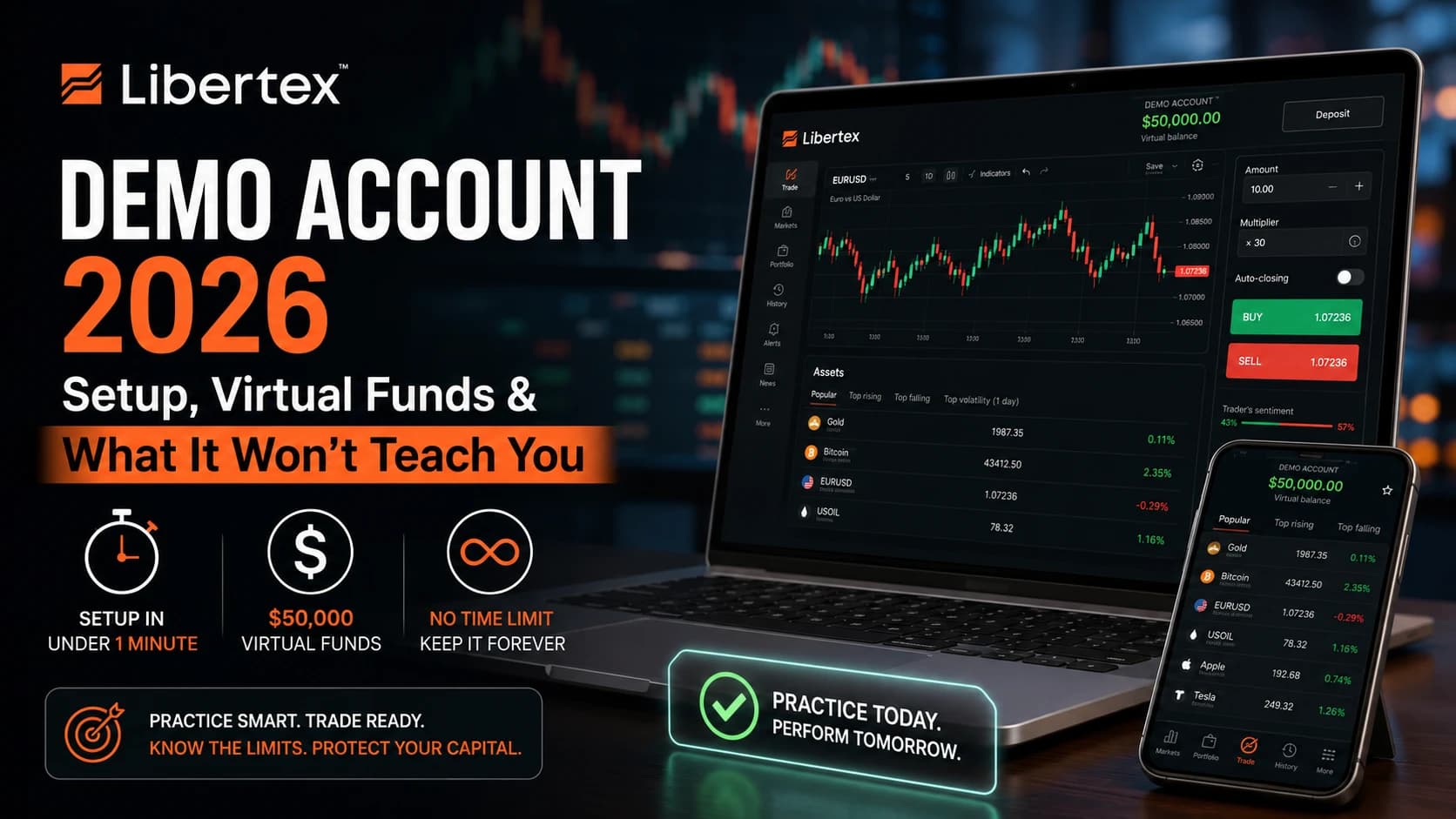
The Libertex demo account is one of the few in this category with genuinely no time limit, and that single fact makes it more useful than most. You can open it in well under a minute, you get $50,000 in virtual funds, and you can keep it open indefinitely. But "useful" and "complete" are not the same thing, and the gap between the two is where most beginners get hurt. This is an honest walk-through of what the demo does, what it quietly leaves out, and how to use it so that the jump to real money is not a shock.
If you are still deciding which demo to use, our CFD demo accounts guide compares the main brokers and explains the deeper limitation that no demo, including this one, can fix.
How to open the Libertex demo account
Registration is deliberately frictionless. You go to the Libertex platform, choose the practice option rather than a live deposit, and the form asks for little more than an email address and a password. There is no funding step and no identity verification to start practising — that only becomes mandatory when you open a live account. Within a few seconds you receive login details and land in the platform with virtual money already loaded.
Two things are worth flagging here. First, the lack of verification is a convenience for the demo but it is not a loophole for live trading: the moment real money is involved, full KYC applies, so do not treat the smooth demo onboarding as a sign that funding and withdrawals will be equally instant. Second, you are signing up with whichever Libertex entity serves your region, and that determines the trading conditions you will eventually face on a live account — which matters more than it first appears (see the leverage section below).
Virtual funds: $50,000, and you can change it
The demo starts with a $50,000 virtual balance. Unlike many competitors, Libertex lets you adjust that figure through an "update demo balance" function, and you can move it in both directions — including entering a negative value to reduce the balance.
That reset-and-adjust feature is the single most underused tool in the account, and it is the one we would push hardest. A $50,000 practice balance is actively misleading if you intend to fund a live account with $500. Position sizes that feel sensible against $50,000 are reckless against $500, and a demo that lets you "win" on oversized trades teaches a habit that will quietly drain a real account. Set the demo balance to the amount you actually plan to deposit. The realism of everything downstream — risk per trade, drawdown tolerance, how a losing streak feels against your capital — depends on getting this one number right.
Platform and supported assets
The Libertex demo runs on the broker's own proprietary platform: a web version and a mobile app for iOS and Android. Inside it you can practise across the full Libertex range — forex, share CFDs, indices, commodities (oil, gas, gold, silver and other metals), and crypto-related instruments including Bitcoin and a selection of crypto ETFs. For getting a feel for the Libertex interface, the order ticket, charts, signals and the general flow of placing and managing trades, the demo mirrors the live environment closely.
One caveat deserves a clear flag. Libertex publishes guides for MetaTrader 4 and MetaTrader 5 demo accounts, and its app listings reference MT4/MT5 access, but the core Libertex demo experience is built around the proprietary platform rather than MetaTrader. If your live plan specifically depends on MT4 or MT5 — for Expert Advisors, custom indicators or a strategy you have already built there — confirm MT4/MT5 demo availability directly in your account before assuming the practice you do on the proprietary platform transfers cleanly. The platforms are not interchangeable, and a demo on the wrong one prepares you for the wrong workflow.
The leverage point DACH and EU traders must not skip
Libertex markets a "multiplier" of up to x999. Read that number with care. For retail clients of Libertex's EU-regulated entity — the one most German, Austrian and Swiss-resident traders will deal with — leverage is capped by ESMA rules enforced through CySEC, not set at the headline marketing figure. The major-forex retail cap is 30:1, with tighter limits on indices, commodities and crypto. The very high multipliers you see advertised apply to clients onboarded under non-EU entities in other jurisdictions.
Why this matters for a demo article: if the practice account lets you trade at a leverage you will never actually be granted as an EU retail client, your demo results are built on conditions that won't exist when you go live. Check what leverage your live entity will permit, and practise at that level. This is exactly the kind of mismatch that makes a profitable demo turn into a losing live account.
What the Libertex demo will not teach you
This is the part most broker-published demo guides skip, and it is the most important. The mechanics — placing orders, setting stop-loss and take-profit, reading the chart — the demo teaches well. The things that actually decide whether you keep your money, it cannot teach at all:
- Trading psychology. No virtual balance triggers the fear, greed and hesitation that real money does. Discipline is effortless when nothing is at stake; it is the entire game when your own capital is on the line.
- Realistic execution. Demos commonly simplify slippage, fills and overnight swap costs. Orders that fill instantly in practice can slip in live markets, especially around news and on larger sizes.
- The cost drag. Spreads, commissions and swap fees are easy to ignore in a demo. In live trading they compound against you, and a strategy that is marginally profitable before costs can be a loser after them.
None of this is unique to Libertex — it is true of every demo on the market, which is precisely the argument of our editorial on demo-account limitations. The fix is not a better demo. It is treating the demo as a flight simulator: it teaches you the cockpit, not the fear of the drop.
Is Libertex a legitimate broker?
For context on whether the platform behind the demo is trustworthy: Libertex's EU-facing entity, Indication Investments Ltd, is authorised and regulated by the Cyprus Securities and Exchange Commission (CySEC) under licence number 164/12. EU retail clients receive negative balance protection, segregated client funds and coverage under the Investor Compensation Fund. Other Libertex entities operate under regulators including the FSC (Mauritius), FSCA (South Africa) and VFSC (Vanuatu) — and the protections differ by entity, so it is worth confirming which one your account is opened under. Regulatory status confirms the broker is licensed; it is not a statement about whether CFD trading is suitable for you.
How to use the demo properly: a short checklist
- Set the virtual balance to your real intended deposit, not the default $50,000.
- Confirm the leverage your live entity will actually grant you, and practise at that level.
- If you plan to trade on MT4/MT5, verify demo access there rather than only on the proprietary platform.
- Trade daily for at least a few weeks to gather real performance data, not a lucky session.
- Keep a log of every trade and your reasoning, so the demo produces evidence rather than just a number.
Frequently asked questions
Does the Libertex demo account expire?
No. The Libertex demo account has no time limit and can be kept open indefinitely, which is one of its main advantages over time-limited demos.
How much virtual money does the Libertex demo give you?
The default balance is $50,000 in virtual funds. You can adjust this up or down using the platform's update-balance function, and we recommend setting it to match your planned live deposit.
Do you need to deposit money to use the Libertex demo?
No. The demo requires no deposit. You only register with an email and password; full verification and funding are required only for a live account.
Can you use the Libertex demo on MetaTrader 4 or 5?
The core Libertex demo runs on the broker's proprietary web and mobile platform. Libertex references MT4/MT5, but you should confirm MetaTrader demo availability directly in your account before relying on it.
Is the Libertex demo account realistic?
It realistically reproduces the platform and order mechanics, but like all demos it cannot reproduce trading psychology, and it tends to simplify slippage and overnight costs. Profitable demo results do not guarantee profitable live trading.
Risk warning: CFDs are complex instruments and come with a high risk of losing money rapidly due to leverage. A high percentage of retail investor accounts lose money when trading CFDs. You should consider whether you understand how CFDs work and whether you can afford to take the high risk of losing your money. A demo account does not eliminate this risk; it only postpones your exposure to it.