Capital.com vs. eToro 2026: Which Broker Wins for Your Strategy?
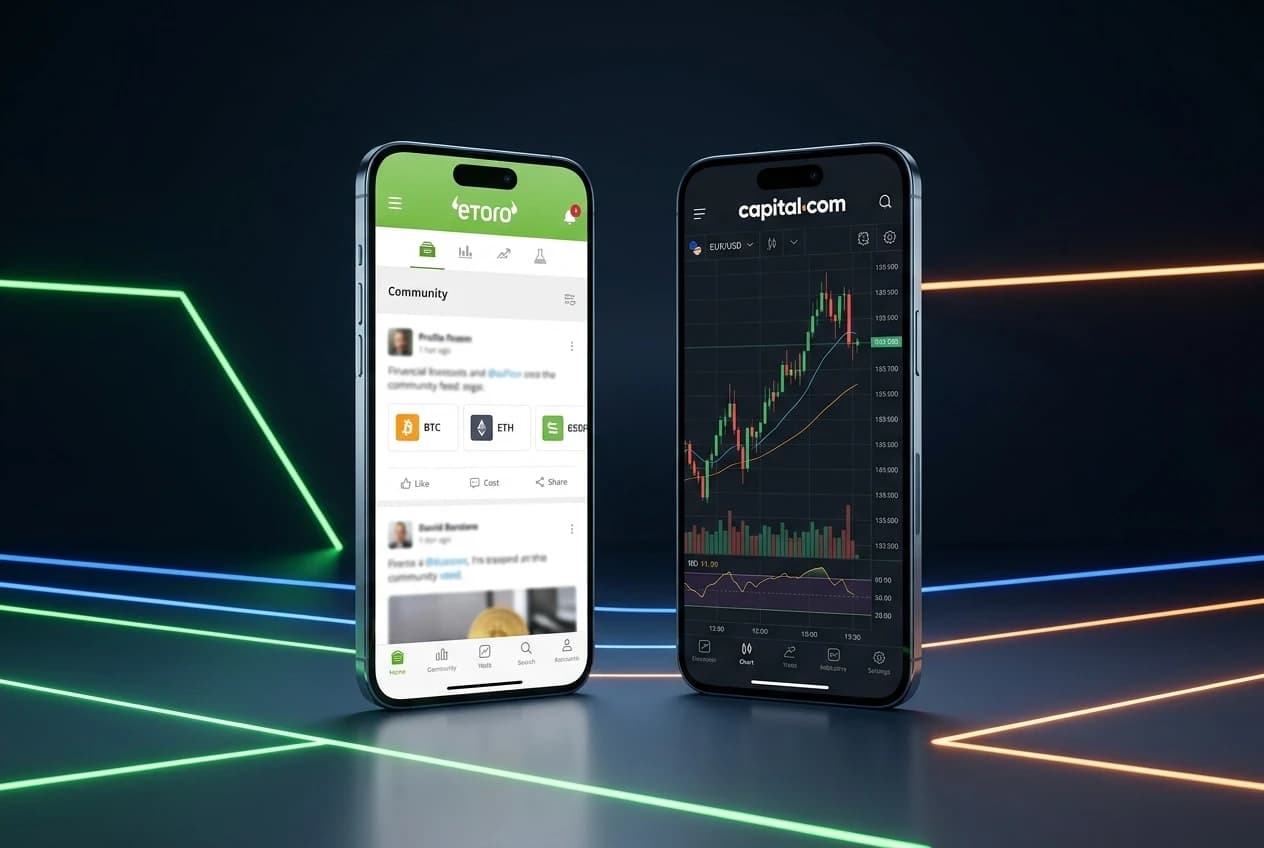
Capital.com and eToro are both tier-1 regulated, both ranked among the top brokers for 2026, and both routinely appear in "best of" lists across major financial media. But they are not interchangeable. They serve genuinely different trader profiles — and choosing between them depends entirely on what you're actually trying to do with the account. This comparison cuts through the marketing claims and lays out the structural differences that matter: cost structure, asset ownership, platform philosophy, and the use cases each one is optimized for.
At a glance
| Feature | Capital.com | eToro |
|---|---|---|
| Best for | Active CFD trading | Multi-asset investing + social trading |
| Regulation | FCA, CySEC, ASIC | FCA, CySEC, ASIC |
| Min. Deposit | $20 | $50 |
| EUR/USD Spread | 0.64 pips avg | ~1 pip |
| Crypto Cost | Spread only (~0.1-0.15%) | 1% spread + 0.6-1% sell fee (1.6-2% round-trip) |
| Real Crypto | No (CFD only) | Yes |
| Social Trading | No | Yes (CopyTrader) |
| Crypto Selection | 400+ CFDs | ~80 real coins |
| Withdrawal Fee | None | $5 (USD) |
| Inactivity Fee | Regional | $10/month after 12 months |
| Platforms | Proprietary + MT4 + TradingView | Proprietary only |
Regulation and trust: structurally even
This is the first thing to check, and it's the easiest comparison: both brokers are tier-1 regulated under the same three authorities. Capital.com holds licenses with the FCA (793714), CySEC (319/17) and ASIC (513393). eToro operates under FCA, CySEC and ASIC across separate UK, European and Australian entities. For DACH users, both default to CySEC oversight with full EU investor compensation protection up to €20,000.
The regulatory differentiation is minimal. Capital.com has an additional Bahamas SCB license (red tier) that's irrelevant for European clients but worth knowing exists. eToro is publicly listed on the Nasdaq under the ticker ETOR (since 2025), which adds public-company financial transparency that Capital.com, as a private entity, doesn't offer. Neither edge is decisive.
Verdict on trust: Even. Both are genuinely safe choices for European traders.
Trading costs: Capital.com is meaningfully cheaper
This is where the comparison gets sharp. Capital.com's commission-free Standard accounts average EUR/USD spreads of 0.64 pips — confirmed by independent live testing. eToro's EUR/USD spreads start at 1 pip and run wider on volatile pairs. For active forex traders, that difference compounds quickly: a 100,000-unit EUR/USD trade costs around $6.40 in spread at Capital.com vs. $10 at eToro.
For cryptocurrency, the gap is wider — and asymmetric. Capital.com offers crypto CFDs with spreads typically in the 0.1–0.15% range. eToro charges a 1% fee when you buy crypto and a 0.6–1% spread when you sell — a round-trip cost of roughly 1.6 to 2 percent. On a $10,000 Bitcoin position, that's $160–$200 to enter and exit at eToro, versus roughly $15–$25 at Capital.com.
Stock trading flips slightly. eToro now charges $1–$2 commission per stock trade outside the US (US stocks remain commission-free, though regulatory fees apply). Capital.com only offers stock CFDs — you never own the underlying share, but you pay only the spread (typically 0.1% on Apple, for example).
Verdict on trading costs: Capital.com wins for active traders and crypto traders. eToro is cost-competitive only on US stocks and ETFs.
Asset range: eToro covers more ground
Capital.com is a specialist. It offers CFDs on roughly 6,400 instruments across forex (147 pairs), indices, commodities, stocks (5,100 CFDs), and cryptocurrency (over 400 crypto CFDs — the largest selection of any broker we reviewed). The depth in any single category is competitive, but it's all CFD-based: you speculate on price, you never own the asset.
eToro covers fewer total instruments but spans more types of ownership. You can buy actual stocks and ETFs (not CFDs), actual cryptocurrencies (around 80 coins available for direct purchase), and trade CFDs on forex, indices, commodities and certain leveraged crypto positions. The platform also supports staking — ETH, SOL, ADA, TRX, NEAR and POL — which generates yield on crypto holdings, something CFD brokers can never offer.
Verdict on asset range: eToro wins for diversified investors; Capital.com wins for breadth within CFD trading. The right choice depends entirely on whether you want to actually own what you trade.
Platforms: different philosophies
Capital.com offers a proprietary web and mobile platform alongside MetaTrader 4 and a TradingView integration. The proprietary platform is clean and modern; the TradingView integration is the standout — for traders who already use TradingView for charting, Capital.com lets you place trades directly from those charts. The AI-powered "Investmate" tutor adds real educational value for beginners learning the platform.
eToro uses only its proprietary platform — no MetaTrader, no TradingView integration. The platform is intentionally simpler, with fewer order types and a streamlined interface aimed at less experienced users. The standout feature is CopyTrader: the social trading system that lets you automatically replicate the trades of top-performing eToro users. There is no equivalent at Capital.com or at most competitors. For traders who want exposure to crypto, stocks or forex without studying the markets themselves, CopyTrader is genuinely useful — though it doesn't eliminate the underlying risk of the copied positions.
Verdict on platforms: Capital.com wins for active traders and TradingView users. eToro wins for beginners and anyone interested in social trading.
Crypto specifically: the structural decision
This is where the choice becomes binary. Both brokers offer cryptocurrency exposure, but the mechanism is fundamentally different.
At Capital.com, every crypto position is a CFD — a derivative contract that pays out based on price movement. You can go long or short, use leverage (up to 1:2 in EU), trade 24/7, but you never own the actual Bitcoin or Ethereum. When you close, you receive cash, not coins. The cost is the spread; the structure is built for trading, not holding.
At eToro, crypto positions can be either real crypto purchases or CFDs, depending on how you structure the trade. If you buy without leverage, you get actual coins held in eToro's custody, transferable to the eToro Money wallet, and stakeable for yield. If you trade with leverage, the position becomes a CFD. This dual structure is rare — most crypto-focused brokers do one or the other.
The practical implication: if you want to trade crypto, especially with leverage or with short positions, Capital.com is the better cost and selection choice. If you want to invest in crypto, hold long-term, earn staking rewards, or transfer to a personal wallet, eToro is the only option of the two that actually works.
Non-trading fees: eToro charges more
Capital.com charges no deposit or withdrawal fees regardless of method, and the inactivity fee situation depends on regional entity (some regions removed it entirely; others retain a $10 monthly charge — verify against your specific account terms). Capital.com applies a 0.7% currency conversion markup when trading instruments denominated outside your account's base currency.
eToro charges a $5 withdrawal fee on USD withdrawals (waived for GBP and EUR in certain regions), a $10 monthly inactivity fee after 12 months of dormancy, and currency conversion fees that vary by Club tier. Crypto transfers from eToro Money wallet to an external wallet incur a 2% fee — meaningful if you plan to self-custody.
Verdict on non-trading fees: Capital.com is meaningfully cheaper — fewer fees, lower friction.
Customer support and reputation
Both brokers face similar criticism patterns in user reviews. The most common complaints at both involve withdrawal delays, KYC verification holdups, and customer support response times. Capital.com has approximately 10% one-star ratings on Trustpilot across 14,000+ reviews; eToro shows comparable distributions with users frequently citing withdrawal delays and high spreads as primary complaints.
Capital.com has earned BrokerChooser's "Best CFD Broker" award for 2026. eToro has earned BrokerChooser's "Best Crypto Broker" award for 2026. Both rankings are credible — they reflect the genuine strengths of each platform in their respective categories.
Verdict on support and reputation: Even, with similar pain points. Neither is exceptional; neither is alarming.
Our verdict: which broker for which trader
Choose Capital.com if you want to:
- Trade CFDs actively, especially crypto CFDs with leverage or shorts
- Minimize per-trade costs (spreads + zero commission)
- Use TradingView, MetaTrader, or a feature-rich proprietary platform
- Trade 400+ crypto pairs (the broadest selection in CFD space)
- Start with a low $20 minimum deposit
Choose eToro if you want to:
- Actually own cryptocurrency and stocks (not just trade their prices)
- Earn staking rewards on ETH, SOL, ADA and other PoS coins
- Use social trading to replicate experienced traders' positions
- Hold a multi-asset portfolio (real stocks + ETFs + crypto) in one account
- Benefit from publicly-listed broker transparency (Nasdaq: ETOR)
Neither one is universally "better." Capital.com is the cleaner choice for active CFD-focused trading; eToro is the better choice for diversified long-term investing with crypto ownership. If you're not sure which describes you, the most honest test is your time horizon: traders who close positions within days favor Capital.com's cost structure; investors who hold positions for months or years favor eToro's ownership model and staking.
For a deeper assessment of Capital.com specifically, see our full Capital.com 2026 review. For the broader crypto broker landscape, see our Best Crypto Brokers 2026 guide.
This analysis represents the editorial assessment of the BrokersRoom Research Desk based on publicly available data and broker-published fee schedules as of May 2026. It is not investment advice within the meaning of § 85 WpHG or analogous legislation. CFD and cryptocurrency trading carries substantial risk — between 63% and 89% of retail investor accounts lose money trading CFDs. BrokersRoom may earn affiliate commissions if you open an account with either broker via a link on this page. Commission rates do not influence our rankings or editorial assessments. Sources: ForexBrokers.com, BrokerChooser, BestBrokers, Capital.com and eToro official pricing documentation. Fee details vary by region and account type — verify against your specific account terms.
Related Articles

Broker News
Demo Accounts at CFD Brokers: The Right Place to Start, the Wrong Place to Stay

Broker News
Spread-Only vs Commission Accounts: Which One Actually Costs You Less?

Broker News
Best CFD Brokers 2026: The 6 Platforms That Actually Deliver

Broker News