Best Crypto Brokers 2026: The 6 Platforms That Actually Deliver

Choosing a crypto broker in 2026 is harder than it should be. The number of platforms has exploded, marketing claims have become indistinguishable, and the distinction between brokers, exchanges and CFD providers gets glossed over in most rankings. This guide cuts through it. We've identified the six crypto brokers that actually deliver — for the specific use case each one fits best. No "Top 50" listicle, no every-broker-on-the-internet roundup. Six picks, clearly differentiated, with the real costs, risks and editorial fits.
How we evaluated
Each broker on this list was assessed on six weighted criteria: regulatory standing (tier-1 licenses preferred), trading costs (spreads, commissions, overnight funding), platform quality, range of cryptocurrencies offered, security and fund segregation, and customer support quality. We also weighted for transparency — brokers that publish full fee schedules and admit their loss rates ranked higher than those that obscure them.
The full methodology behind our broker scores is documented on our Methodology page. We earn affiliate commissions from some brokers on this list — the disclosure block at the end covers that in full. Commission rates never influence rankings; the broker that pays us more does not rank higher.
Quick Comparison
| Broker | Best For | Regulation | Min. Deposit | Real Crypto? |
|---|---|---|---|---|
| eToro | Overall + Social Trading | FCA, CySEC, ASIC | $50 | Yes |
| Capital.com | CFD Trading (400+ pairs) | FCA, CySEC, ASIC | $20 | No (CFD only) |
| Interactive Brokers | Professional Traders | FCA, SEC, multiple | $0 | Yes |
| Plus500 | Beginners | FCA, CySEC, ASIC | $100 | No (CFD only) |
| Bitpanda | European Investors | BaFin, FMA | €1 | Yes |
| Pepperstone | Active CFD Traders | FCA, ASIC, CySEC | $0 | No (CFD only) |
1. eToro — Best Overall Crypto Broker
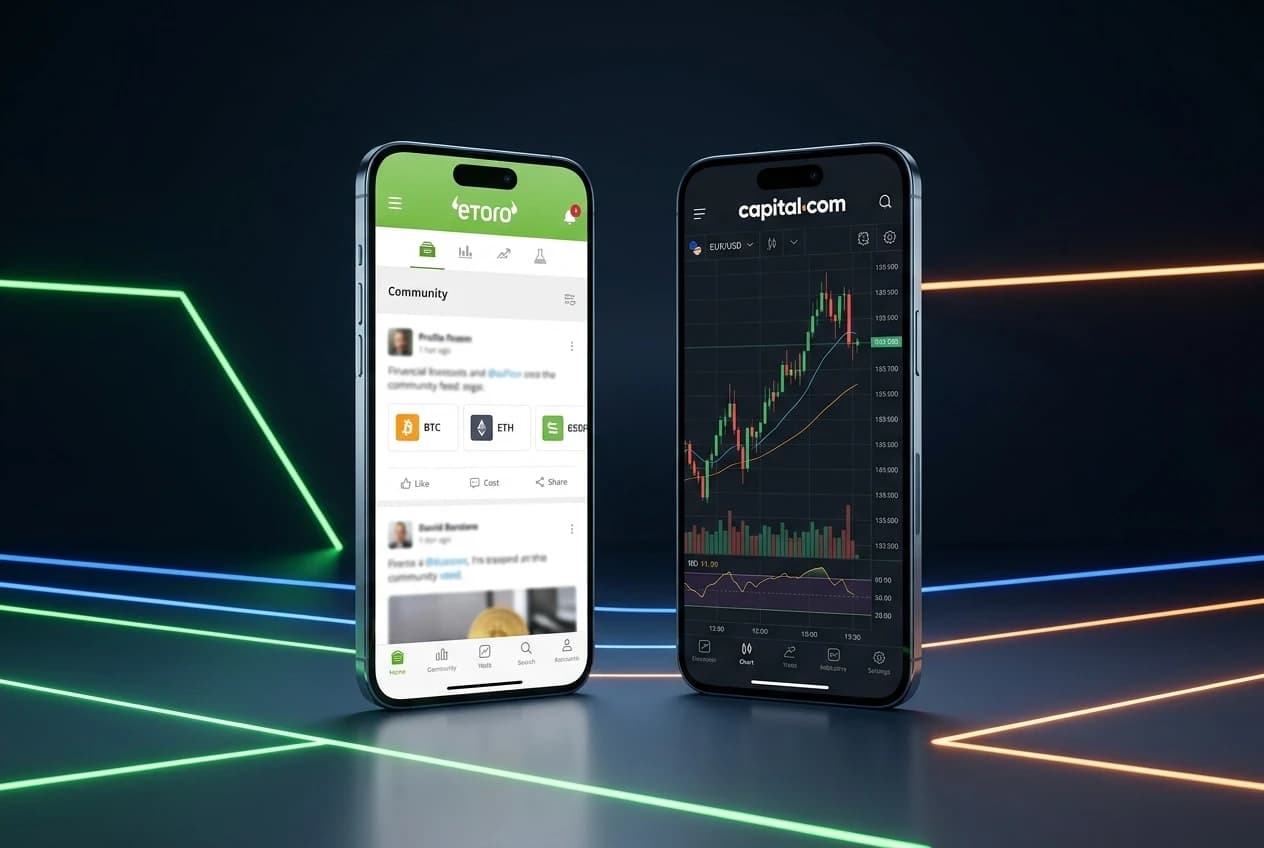
eToro is the broker most independent reviewers settle on as the 2026 leader, and the reasoning holds up. It is one of very few platforms that lets you trade both real cryptocurrencies and crypto CFDs under one regulated account, giving you genuine flexibility depending on whether you want to invest long-term or trade with leverage. Regulation across FCA, CySEC and ASIC puts it firmly in the tier-1 bracket.
The platform's standout feature is CopyTrader — a social trading system that lets you automatically replicate the trades of top-performing eToro users. For beginners who want crypto exposure without studying technical analysis, this is the most accessible entry point in the industry. The mobile app is clean, the onboarding takes minutes, and the crypto wallet is custodial but functional.
Where eToro is not the best choice: active day traders looking for the tightest spreads. eToro's crypto spreads are wider than CFD-only competitors — Bitcoin typically trades with around 1% spread, which is fine for occasional buys but expensive for high-frequency trading. The minimum deposit of $50 is also higher than CFD-only brokers, though it remains accessible.
Pros: Real crypto + CFDs in one account · Social trading · Beginner-friendly · Strong regulation
Cons: Wider spreads on crypto · 1% withdrawal fee · CFD positions face inactivity charges after 12 months
2. Capital.com — Best for Crypto CFD Trading
If your strategy is leveraged crypto trading on a wide range of pairs, Capital.com is the clear leader. The broker offers over 400 crypto CFDs — the largest selection of any broker we reviewed — alongside a commission-free pricing model where costs are built into competitive spreads. EUR/USD averages 0.64 pips; Bitcoin CFDs trade at roughly 80–100 USD spread, depending on volatility.
Regulation is solid: FCA (UK), CySEC (Cyprus) and ASIC (Australia) for the main entities, all tier-1. The platform is proprietary and works well across web and mobile, with TradingView integration for traders who prefer that charting environment. The AI tutor "Investmate" is a genuine differentiator for beginners learning the platform.
Two honest caveats. First, Capital.com is CFD-only — you cannot buy and hold actual Bitcoin or Ethereum here. You speculate on price movements with leverage, full stop. Second, the broker's published loss rate ranges from 63% to 81.7% across regions, with the upper end above the industry average of 74–76%. CFD trading is high-risk by definition, and Capital.com's data confirms that most retail traders lose.
For a complete breakdown, see our Capital.com 2026 review.
Pros: 400+ crypto CFDs · Commission-free · Tight spreads · Strong regulation
Cons: CFD only (no real ownership) · Loss rate up to 81.7% · Currency conversion fee in some regions
3. Interactive Brokers — Best for Professional Traders
Interactive Brokers is in a different category from the consumer-focused brokers on this list. It is the platform institutional and professional traders use, and in 2026 that institutional infrastructure extends to genuine cryptocurrency holdings. You can buy and hold Bitcoin, Bitcoin Cash, Ethereum and Litecoin directly without needing a separate crypto wallet — a meaningful structural advantage over most competitors.
Commission rates are among the lowest in the industry: around 0.12% to 0.18% per trade with a $1.75 minimum, far below the 1%+ markups typical at consumer-focused exchanges. The platform also offers exposure to crypto derivatives like CME Bitcoin futures and crypto indices such as the NYSE Bitcoin Index — instruments that simply don't exist at most brokers.
The trade-off: Interactive Brokers' platform has a steep learning curve. The TWS workstation is powerful but intimidating for casual users, and the account opening process is more demanding than at consumer-focused alternatives. This is not the broker for first-time crypto buyers. For experienced traders or those moving from professional finance backgrounds, the cost savings and feature breadth justify the complexity.
Pros: Lowest commissions · Real crypto + derivatives · Multi-asset institutional platform · No wallet needed
Cons: Steep learning curve · More demanding account opening · Limited cryptocurrency selection vs. specialized exchanges
4. Plus500 — Best for Beginners in CFD Trading
Plus500 has built its reputation on a single principle: keep the platform simple enough that anyone can use it. For someone new to crypto trading who wants leveraged exposure without learning complex tools, Plus500 is the lowest-friction entry point in the regulated CFD space. The interface is famously clean, the order types are limited to the essentials, and the regulatory standing is solid — FCA, CySEC, ASIC, MAS and others.
The broker offers crypto CFDs on roughly 20 to 25 major cryptocurrencies — far fewer than Capital.com, but covering the assets most beginners actually trade. Spreads are reasonable, with Bitcoin typically running around 80–120 USD. The mobile app and web platform share the same simplified design.
The honest weaknesses: Plus500 charges an inactivity fee of $10 per month after three months of dormancy — much faster than industry norms — and the platform lacks the advanced charting tools that active traders rely on. The $100 minimum deposit is also higher than several competitors. Plus500 is built for traders who want a clean, simple experience, not for those who will outgrow it within a year.
Pros: Cleanest platform in the CFD space · Strong regulation · Simple onboarding
Cons: Higher inactivity fee · Fewer crypto pairs than competitors · Limited advanced tools
5. Bitpanda — Best for European and DACH Investors
For traders in the German-speaking region — Germany, Austria, Switzerland — Bitpanda occupies a unique position. The Vienna-based exchange holds licenses from BaFin (Germany) and the FMA (Austria), making it one of very few crypto platforms with direct DACH regulatory approval rather than only EU-wide CySEC standing. For users who want their crypto held under home-jurisdiction supervision, this matters.
Bitpanda is not a CFD broker — it's a real crypto exchange. You buy actual Bitcoin, Ethereum, and roughly 400 other cryptocurrencies, and you can choose between custodial holding and self-custody via the Bitpanda Wallet. The platform also offers fractional stock investing, ETFs and precious metals from a single account, which is unusual in the crypto space and useful for portfolio diversification.
Costs are fair but not the cheapest. The premium service charges around 1.49% per trade for crypto purchases, which is competitive with Coinbase but more expensive than dedicated low-cost exchanges like Kraken. Where Bitpanda wins is the local infrastructure: SEPA deposits arrive same-day, German and Austrian customer support is genuinely fluent, and the tax reporting integrates with regional tools.
Pros: BaFin and FMA regulated · Real crypto ownership · Multi-asset (crypto + stocks + metals) · DACH infrastructure
Cons: Higher per-trade fees · Less suitable for active trading · No leverage
6. Pepperstone — Best for Active CFD Traders
Pepperstone is the active trader's broker. Founded in Australia in 2010, it has built a reputation for institutional-grade execution and some of the tightest spreads in the CFD market. For Bitcoin CFD positions, Pepperstone typically offers spreads from $40 to $60 — significantly tighter than Plus500 or eToro — making it the better choice for traders who place high frequency.
The broker supports both MetaTrader 4 and 5, cTrader and TradingView, giving active traders their preferred environment rather than forcing a proprietary platform. Regulation across FCA, ASIC, CySEC, DFSA, BaFin and others is comprehensive. The Raw Spread account adds a small commission ($3.50 per lot per side) in exchange for near-zero spreads — the classic professional structure.
Pepperstone is not the right choice for beginners. The platform assumes you know what spreads, swaps, and lots are. The educational materials exist but are not the focus. Crypto selection is also narrower — around 30 to 40 crypto CFDs, similar to Plus500.
Pros: Industry-leading execution · Tight spreads · Multi-platform support · BaFin regulation
Cons: Steeper learning curve than Plus500 · Fewer crypto pairs than Capital.com · CFD only
What to look for in a crypto broker
The right broker depends entirely on what you're trying to do. Five questions cut through the marketing noise:
Do you want to own actual crypto, or speculate on price? If you want real coins you can withdraw, you need an exchange (Bitpanda, Coinbase, Kraken) or a broker that holds actual crypto (eToro, Interactive Brokers). CFD-only brokers like Capital.com, Plus500 and Pepperstone never give you the underlying asset — you only gain or lose based on price movements.
What's your trading frequency? Active day traders should prioritize tight spreads (Pepperstone, Interactive Brokers). Occasional buy-and-hold investors can accept wider spreads in exchange for ease of use (eToro, Bitpanda).
Where are you based? Regulatory protection only applies if you trade with the broker's local entity. DACH residents fall under CySEC or BaFin oversight at most international brokers — fine, but Bitpanda's home-jurisdiction supervision is structurally stronger if you're Austrian or German. US residents face severely restricted options due to local regulation.
How much complexity can you handle? Interactive Brokers and Pepperstone require real platform competence. eToro and Plus500 are intentionally simple. Match the platform to your current skill level, not your aspirational one.
What's your risk tolerance? Between 63% and 89% of retail CFD traders lose money — depending on the broker and reporting period. This is not a flaw in any specific broker. It's a fundamental feature of leveraged trading. If preserving capital matters more than upside, real-crypto exchanges are usually the wiser choice.
CFDs vs. real cryptocurrency: the structural choice
This deserves its own moment of clarity because it's where most beginners trip up.
CFDs (Contracts for Difference) let you bet on the price of Bitcoin or Ethereum without ever owning them. You can go long or short, use leverage, and trade 24/7 — but the cryptocurrency itself never enters your wallet. CFDs are derivatives. When you close your position, you receive cash, not coins.
Real crypto means you buy Bitcoin, Ethereum or another coin, and the broker either holds it for you (custodial) or transfers it to your wallet (non-custodial). You actually own the asset. You can send it to other wallets, use it in DeFi, hold it indefinitely.
Neither approach is inherently better — they solve different problems. Traders typically want CFDs for the leverage and short-selling capability. Long-term investors typically want real crypto for the actual ownership and the option of self-custody. Some brokers (eToro, Interactive Brokers) offer both; many specialize in one.
Our verdict
For most people starting in 2026: eToro is the safest first choice, because the dual real-crypto + CFD structure means you don't have to commit to one approach before you understand which fits you. Strong regulation, simple platform, optional social trading.
For active CFD traders who already know what they're doing: Capital.com for breadth (400+ pairs) and Pepperstone for execution (tighter spreads).
For long-term crypto investors in DACH: Bitpanda, with home-jurisdiction regulation that no international broker can match for you.
For professionals: Interactive Brokers, no contest — the cost advantage compounds significantly at scale.
For absolute beginners who only want to dip a toe in: Plus500, accepting the higher inactivity fee in exchange for the simplest interface in the regulated CFD space.
This analysis represents the editorial assessment of the BrokersRoom Research Desk based on publicly available data and live broker testing where applicable. It is not investment advice within the meaning of § 85 WpHG or analogous legislation. Cryptocurrency and CFD trading carries substantial risk — between 63% and 89% of retail investor accounts lose money trading CFDs. BrokersRoom may earn affiliate commissions if you open an account with any of the brokers listed via links on this page. Commission rates do not influence our rankings or editorial assessments. Sources: ForexBrokers.com, BrokerChooser, BestBrokers, DayTrading.com, official broker fee schedules. As of 27 May 2026.