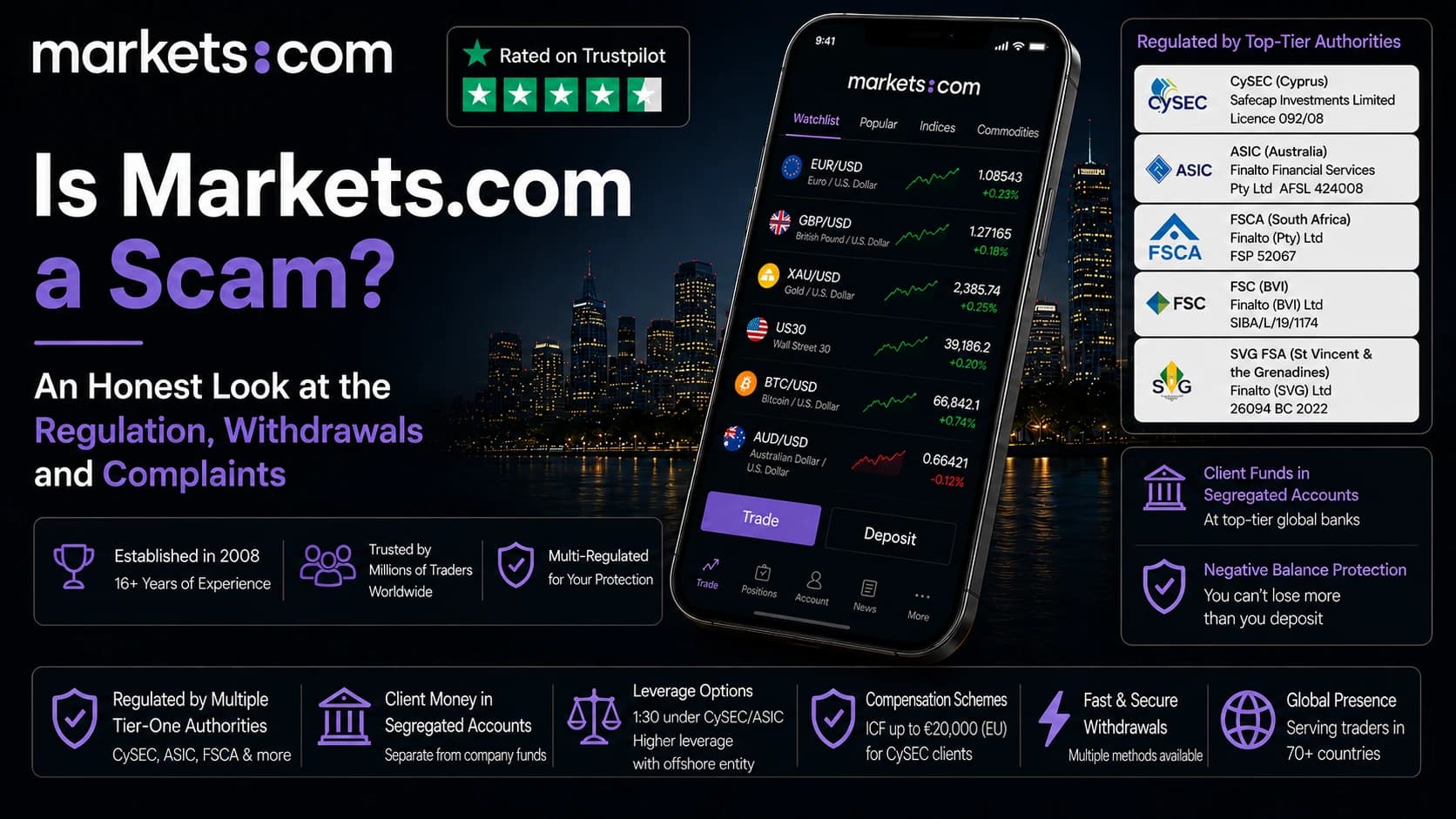
The short answer first: no, Markets.com is not a scam. It is a multi-regulated CFD broker that has operated since 2008, regulated for retail clients by CySEC in the EU and the FSCA in South Africa, with client funds held in segregated accounts. The negative posts you'll find online are real, and Markets.com has a few genuine friction points worth understanding — but they describe trading losses, offshore-entity differences and impersonation websites, not fraud by the broker. Here is the honest breakdown, including two facts most reviews still get badly wrong.
If you've searched "Markets.com scam" before depositing, good — that caution is exactly right. So here are the facts.
Is Markets.com regulated and safe?
Yes — but which regulator protects you depends entirely on where you live, and this is where you need to read carefully, because the gap between the genuine licences and the offshore ones is wide. Markets.com is the retail brand of the Finalto Group. EU clients are served by Safecap Investments Limited, regulated by CySEC under licence 092/08 — a genuine tier-one EU regulator, with MiFID protections, retail leverage capped at 1:30 and Investor Compensation Fund cover up to €20,000. South African clients are served by a Finalto entity licensed by the FSCA. International clients, however, are routed to offshore arms registered in the British Virgin Islands and St Vincent & the Grenadines. Across these entities client money is held in segregated accounts and negative balance protection applies.
The catch is what "regulated" means at the offshore end. The St Vincent entity is a company registration, not meaningful CFD supervision — the SVG financial authority openly states it does not regulate forex and CFD activity. And leverage tells the same story: where CySEC caps you at 1:30, the FSCA and offshore entities go as high as 1:1000. That isn't a perk; it's a far faster way to lose your deposit, and it signals a much lighter regulatory touch than the EU arm.
The two facts most reviews get wrong
Here is where almost every other "Markets.com review" is now out of date, and getting this right matters more than any reassurance.
First, the UK. Countless articles still tell you Markets.com is "FCA-regulated" with FSCS protection up to £85,000. For a new client, that is no longer true: Markets.com stopped onboarding UK retail clients in late 2024, citing the rising regulatory burden. The Finalto group still holds FCA authorisation through its UK entities, but that now covers its institutional business — not new retail sign-ups. If a review is selling you FCA and FSCS cover, it is describing a door that has closed.
Second, the ownership. Many sites still claim Markets.com is "part of Playtech," the London-listed FTSE 250 group, implying public-company oversight. That ended in July 2022, when Playtech sold its Finalto division to Hong Kong-based Gopher Investments in a $250 million deal. Markets.com today sits inside a privately held group, not a listed company. That doesn't make it unsafe — its regulation is what counts — but any review still citing the Playtech connection is years behind, and you should treat its other claims with the same caution.
Then why are there "Markets.com scam" complaints?
Three reasons. The first is the universal one: most people who trade leveraged CFDs lose money, and losers frequently blame the broker for "manipulating" prices when a position is simply stopped out. The second is impersonation — there are documented cases of fraudsters promoting fake "Markets.com" apps through messaging platforms like WeChat, then refusing withdrawals. Those victims were scammed by a clone, not the real broker, so always confirm you're on the official markets.com domain and check the licence in the regulator's register.
The third is withdrawals, and here the honesty has to cut deeper than usual. Beyond the routine KYC-related delays that every regulated broker has, there is at least one serious, publicly documented dispute in which a client trading under the South African entity had a large withdrawal rejected on "liquidity abuse" grounds and escalated the matter to the FSCA and the FAIS Ombud. "Liquidity abuse" or latency-arbitrage clauses are a genuine grey area in CFD contracts rather than outright theft, but it underlines why you must read the terms on trading style before funding a large account.
The criticisms that are fair
Markets.com routes international clients to offshore entities — including a St Vincent arm that is registered rather than genuinely supervised — offering leverage as high as 1:1000, with far lighter protection than CySEC provides. It charges a currency-conversion fee and a $10 monthly inactivity fee after 90 days. Educational material is fine for beginners but thin for advanced traders. It no longer onboards UK retail clients, and doesn't accept clients from the US, Canada, Japan, Singapore or Belgium either. Its regulatory history isn't spotless: CySEC fined the operating entity Safecap €168,000 back in 2015 — old news, but a reminder that regulators do hold it to account. And, as above, withdrawal terms around trading style deserve close reading. None of this is fraud, but all of it is worth knowing before you fund an account.
The verdict
Markets.com is a legitimate, long-established, multi-regulated broker — not a scam. But it sits a notch below the most transparent names on this list: the ownership is now private rather than publicly listed, international clients can land on a lighter-protected offshore entity, and the withdrawal terms reward careful reading. Confirm the official domain, check which entity holds your account, read the terms on your trading style, and judge it on that basis. For the full breakdown of spreads, platforms and account types, see our complete Markets.com review.
Editorial commentary, not financial advice. CFDs are complex instruments and carry a high risk of losing money rapidly due to leverage; most retail accounts lose money. Only trade with capital you can afford to lose.