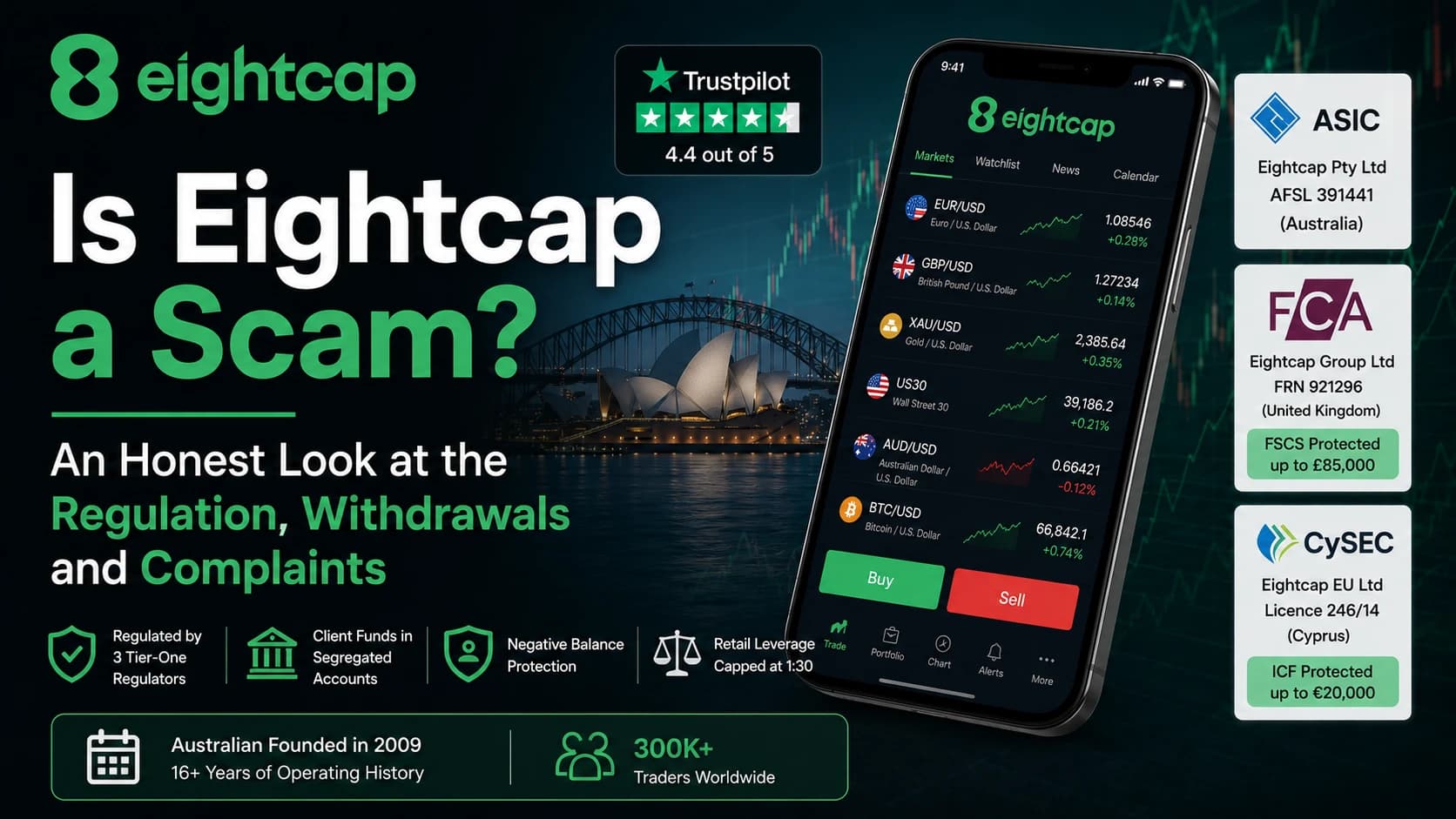
The short answer first: no, Eightcap is not a scam. It is an Australian-founded broker, in business since 2009, holding licences from three tier-one regulators — ASIC, the FCA and CySEC — with client funds held in segregated accounts. The negative reviews you will find online are real, but they overwhelmingly describe trading losses and the broker's known limitations, not fraud. There is one genuine nuance worth understanding, though, and we cover it below.
Searching "Eightcap scam" before you deposit is the right instinct — caution is what protects traders. So here are the facts, including the criticism that actually holds up.
Is Eightcap regulated and safe?
Yes, and its core regulatory footprint is strong. Eightcap was founded in Melbourne in 2009 and operates through several separately licensed entities. In Australia, Eightcap Pty Ltd holds ASIC licence 391441. In the UK, Eightcap Group Ltd is authorised by the Financial Conduct Authority under reference 921296. In Europe, Eightcap EU Ltd holds CySEC licence 246/14. These three are all tier-one regulators that require capital adequacy, regular reporting, segregated client money and negative balance protection. UK clients are covered by the FSCS up to £85,000 and EU clients by the Cyprus Investor Compensation Fund up to €20,000.
Across these entities, your funds sit in segregated accounts at tier-one banks, kept separate from the company's own capital, and retail leverage is capped at 1:30. With more than sixteen years of operating history and no major regulatory sanctions, Eightcap sits firmly in the regulated-broker category, well above the offshore-only crowd.
The one nuance you should understand
Here is the detail most "scam" reviews miss, and it is the single most useful thing on this page. Eightcap also runs an offshore entity — Eightcap Global Limited, registered with the Securities Commission of the Bahamas under SIA-F220 — which serves many international clients who don't qualify for the Australian, UK or EU arms. That entity offers far higher leverage, up to 1:500, but a lighter protection framework than ASIC, the FCA or CySEC. It is still regulated; it is simply a different tier. Which Eightcap entity holds your account determines both your protections and your maximum leverage, so before you fund anything, check your client agreement to see which one you are signing up with. This is not fraud — but it is the kind of thing a careful trader wants to know.
Then why are there "Eightcap scam" complaints?
For the reason every CFD broker attracts them: most people who trade leveraged CFDs lose money — the figure regulated brokers must display sits well above 70% of retail accounts. When a trader over-leverages (and the Bahamas entity's 1:500 makes that easy), gets stopped out, or hits an automatic margin closeout, it feels like the broker engineered the loss, when it is the risk mechanism working as designed.
Withdrawals produce the second cluster. Funds held pending identity verification feel "blocked," but anti-money-laundering law requires that check before any payout. A broker that verifies your documents before releasing money is showing diligence, not deceit. Completing KYC early removes nearly all of this friction.
The criticisms that are fair
Honesty cuts both ways. Eightcap runs no platform of its own, relying on third-party software — MT4, MT5, TradingView and TradeLocker — and which of these you get depends on your entity. Its in-house research and education are thinner than larger rivals offer. Copy trading is limited and, in some testing, effectively unavailable. Customer support draws mixed feedback. And, as above, international clients often land on the lighter-protected Bahamas entity by default. None of this is fraud, but all of it is worth knowing before you fund an account.
The verdict
Eightcap is a legitimate, tier-one-regulated broker with a long track record — not a scam. The real risks are the leverage itself, which will empty an account far faster than any fraudster, and signing up under the offshore entity without realising the protections differ. Check which entity holds your account, complete your KYC early, understand the leverage you're being offered, and judge Eightcap for what it is. For the full breakdown of spreads, platforms and account types, see our complete Eightcap review.
Editorial commentary, not financial advice. CFDs are complex instruments and carry a high risk of losing money rapidly due to leverage; most retail accounts lose money. Only trade with capital you can afford to lose.